The current integration of AI into brand development reveals a consistent and structurally grounded problem. The outputs are often technically proficient, formally coherent, and immediately deployable. Yet in many cases, they remain conceptually weak and strategically unusable. This discrepancy cannot be explained by deficiencies in execution. It points instead to a fundamental difference in how meaning is produced.
Podcast on Spotify
In design theory, abstraction is not a matter of simplification but of epistemic reduction.
It describes a process in which complexity is not eliminated but reorganized into a condensed form that retains semantic density. This requires the ability to distinguish between what is essential and what is contingent. It is, in other words, a question of judgment. This principle is historically well established. Within the Bauhaus, reduction functioned as a methodological tool to align form and purpose. In the work of Dieter Rams, this approach is translated into a design ethic grounded in clarity, restraint, and necessity. Similarly, in the visual arts, positions such as Kazimir Malevich or Donald Judd demonstrate that radical reduction does not diminish meaning but intensifies it through structural precision.


Across these contexts, reduction operates as a selective mechanism. It is not additive but subtractive. The design process advances by eliminating variables until a stable and meaningful configuration emerges. This process presupposes an understanding of context, use, and intention. It cannot be derived from formal similarity alone. At this point, the limitations of current AI systems become evident. Generative models are based on statistical inference. They identify patterns within large datasets and produce outputs that correspond to learned distributions. While this enables a high degree of formal plausibility, it does not entail an understanding of semantic relevance. AI does not determine what is necessary. It determines what is probable.
In the context of brand development, this distinction is critical. Brands function as condensed systems of meaning. Their effectiveness depends on differentiation, coherence, and recognizability. These qualities are achieved through reduction. A logo, a typographic system, or a verbal identity must be stripped of redundancy in order to become distinctive.

Empirically, AI-generated brand artifacts tend to exhibit the opposite tendency. Logos are often interchangeable, claims lack strategic direction, and visual systems appear overdetermined. The outputs resolve too many possibilities simultaneously, resulting in a loss of hierarchy and focus. What emerges is not abstraction, but accumulation.
Minimalism, in this regard, is frequently misinterpreted as a stylistic category.
From a design-theoretical perspective, however, it is better understood as the outcome of iterative elimination. Each remaining element has passed a threshold of necessity. The system reaches a point at which further reduction would compromise its integrity. This threshold cannot be calculated statistically. It must be evaluated.
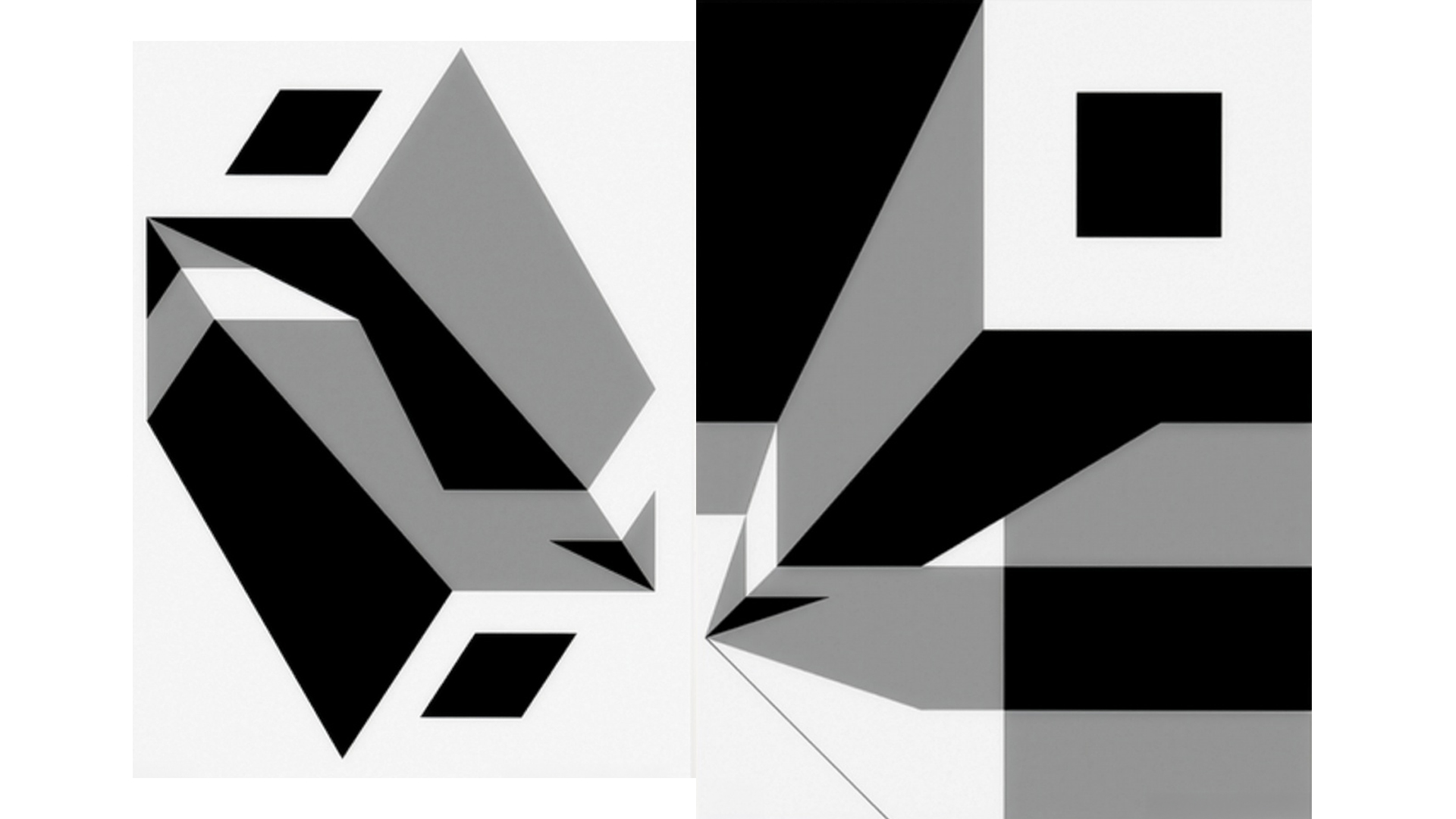
A particularly instructive body of work in this context is Op Art, as documented by the Schirn Kunsthalle Frankfurt and published by Verlag der Buchhandlung Walther König. The positions represented there demonstrate how reduction operates as a generative constraint.
Artists such as Jesús Rafael Soto construct perceptual environments based on linear repetition and spatial interference. Alberto Biasi develops modular systems that shift in relation to the viewer’s movement. Helga Philipp reduces visual language to interference patterns that operate at the limits of perceptual stability. Günter Fruhtrunk employs strictly organized color sequences and diagonal structures to generate tension. Milan Dobeš constructs spatial effects through minimal geometric intervention. Marina Apollonio creates rotational systems that produce movement through formal restriction.


What unites these approaches is not a shared aesthetic but a shared methodology. Each work is based on a limited set of parameters. Complexity emerges from the interaction of these parameters, not from their expansion.
The reduction of variables increases, rather than decreases, the intensity of the perceptual experience.
This logic is directly transferable to brand development. A brand is not a collection of expressive elements but a constrained system that generates meaning through consistency and differentiation. Its strength depends on the precision of its reduction.
AI systems, however, are not designed to operate under such constraints. Their objective is to approximate distributions, not to establish necessity. As a result, they tend to reproduce existing patterns and converge towards the mean. In branding, this leads to solutions that are formally acceptable but strategically indistinct. A further limitation concerns the role of absence. In both art and design, meaning is often produced through what is not explicitly articulated. Reduction creates space for interpretation and appropriation. This open structure is central to the longevity and adaptability of brands.


AI, by contrast, exhibits an inherent tendency toward completion. Faced with indeterminacy, it resolves by addition. This reduces ambiguity but also eliminates the productive tension that is essential for meaning-making.
The current limitations of AI in abstraction and minimalism should therefore not be understood as temporary shortcomings, but as structural characteristics of probabilistic systems. This does not diminish their value. AI is highly effective in generating variations, exploring formal possibilities, and accelerating early design phases.
However, the decisive step in design remains the act of reduction. The question of what can be removed, and what must remain, cannot be delegated. It requires judgment, context awareness, and intention.
In this sense, abstraction remains a fundamentally human practice.
Image Credits & References
Tate. (n.d.). Penetrable, Jesús Rafael Soto. Retrieved April 12, 2026, from https://www.tate.org.uk
Schirn Kunsthalle Frankfurt. (2007). Op Art: Catalogue of the exhibition. Frankfurt am Main: Schirn Kunsthalle Frankfurt.
Verlag der Buchhandlung Walther König. (2007). Op Art (Exhibition catalogue). Cologne: Walther König.
Slovak National Gallery. (n.d.). Central Gravity, Milan Dobeš. Retrieved April 12, 2026, from https://www.sng.sk
Solomon R. Guggenheim Museum. (n.d.). Forma-colore gradazione 20N, Marina Apollonio. Retrieved April 12, 2026, from https://www.guggenheim.org