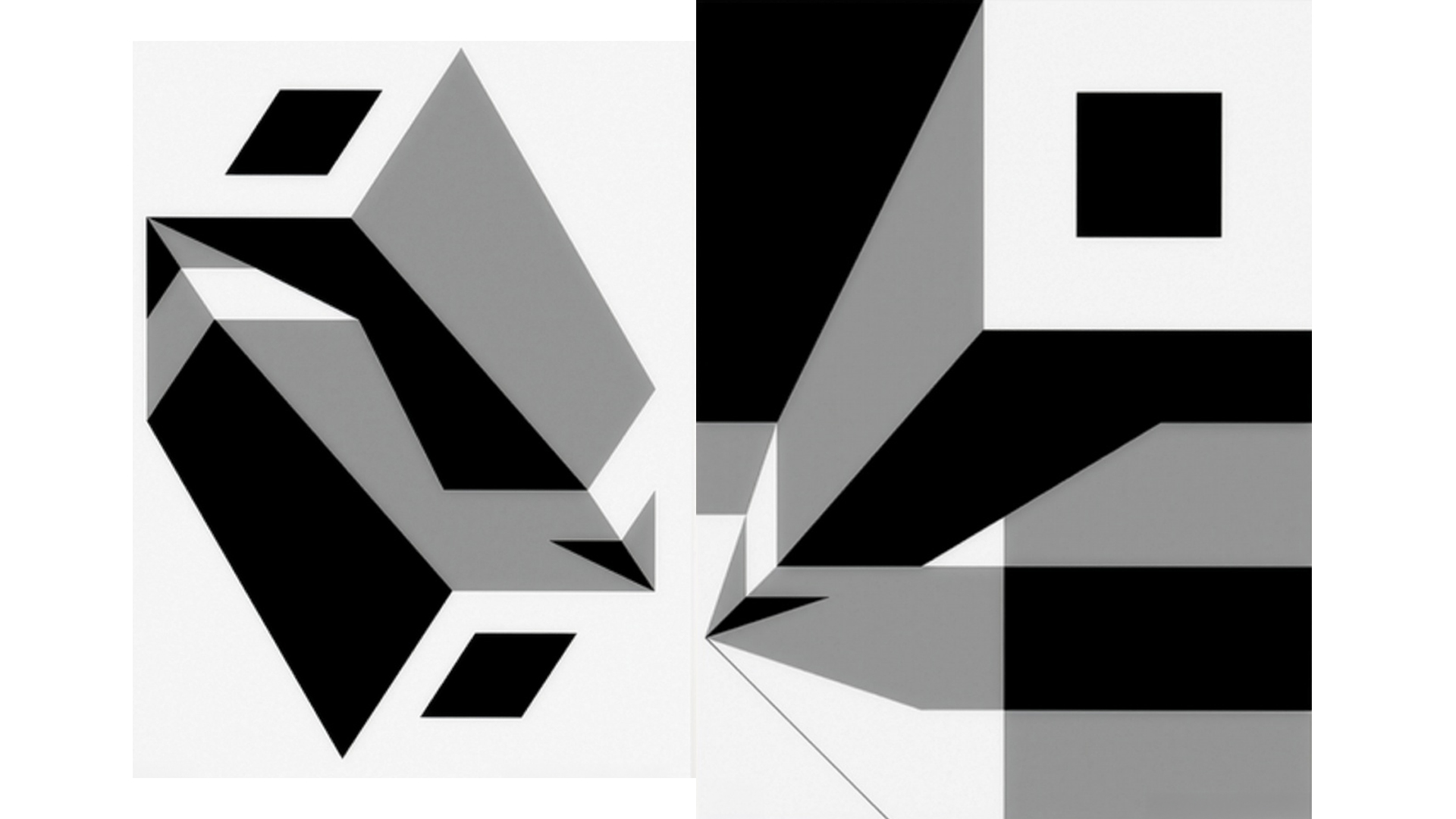
The recent exhibition on Raoul Hausmann at the Berlinische Galerie offered a compelling reminder of how relevant many questions of the historical avant-garde remain today. Looking at Hausmann’s photomontages, typographic experiments, and theoretical writings, one is struck by how familiar their visual logic feels.
Podcast on Spotify
Fragmentation, recombination, serial structures, and the dissolution of traditional authorship are no longer confined to the artistic experiments of the 1920s; they have become defining characteristics of contemporary design practice.


Yet it would be a misunderstanding to interpret Dada as an early precursor of generative design. The similarities are obvious. The differences, however, are far more revealing. Although both operate through fragments, systems, and open processes, they pursue fundamentally different cultural objectives.


Dada and the Crisis of Meaning
Dada emerged during a period of profound social and political upheaval. The First World War had shattered confidence in progress, rationality, and established systems of order. The Dadaists responded not with new certainties, but with doubt. Their work challenged conventional forms of representation, linear narratives, and the assumption that meaning could ever be stable, objective, or fully controlled.


For artists such as Raoul Hausmann, Hannah Höch, Kurt Schwitters, and John Heartfield, collage was far more than a visual technique. It was a method for exposing the fragility of existing systems of meaning. Images were dismantled, texts were removed from their original contexts, and meanings were deliberately placed in conflict with one another. Their works generated friction, contradiction, and ambiguity. Their achievement was not the creation of new forms of order, but the exposure of how unstable order itself can be.


From Composition to Computation
From a contemporary perspective, this feels remarkably relevant. Over the past two decades, design has similarly moved away from static forms toward systems, processes, and rules. Designers increasingly work with frameworks rather than fixed outcomes, with relationships rather than objects, and with behaviors rather than singular artifacts.


This development extends from the early artistic experiments of John Maeda to the generative practices of Ben Fry and Joshua Davis, and continues through contemporary design studios such as FIELD.IO, Onformative and Universal Everything.


What unites these positions is an understanding of design as a system. Form no longer emerges solely through direct formal decisions, but through rules, parameters, data, and relationships. Design becomes a process that produces outcomes rather than determining them completely in advance.
The Difference Between Fragmentation and Organization
It is precisely here, however, that the distinction from Dada becomes visible. The Dadaists used fragments to challenge coherence. Generative design often uses systems to create coherence. Dada worked against order. Generative design generally works through order.
This is not meant as criticism. The challenges faced by contemporary designers differ fundamentally from those of the early twentieth century. Today’s practitioners must navigate complex brand ecosystems, digital platforms, and continuously evolving communication environments. Variable identities, adaptive interfaces, and data-driven systems respond to a world defined by connectivity and constant change. Yet this shift also transforms the cultural role of design itself.


Where the historical avant-garde cultivated uncertainty, contemporary design often translates uncertainty into systems. Variability becomes manageable. Openness exists within predefined structures. The unexpected remains possible, but only within a controlled framework.
Openness as a Property of the System
This is particularly evident in the development of contemporary brand identities. Many organizations have replaced static logos with dynamic visual systems. Color palettes, typography, motion, and graphic elements continuously adapt to changing contexts. Identity appears flexible, responsive, and open.
At the same time, this openness remains highly organized. Variations follow rules. Adaptation occurs within carefully designed structures. Openness becomes a property of the system itself. This may be the most significant distinction between Dada and contemporary generative design.
For Hausmann and Höch, chance was a means of undermining control. For many contemporary design systems, variability becomes a means of maintaining control. The system remains stable even as its visual manifestations change.


The Role of Irritation
The question, therefore, is not whether generative design can be creative. It clearly can. The more interesting question is what role disruption still plays within contemporary design culture.


The historical avant-garde understood design as an intervention into existing systems of perception. Its objective was not simply to produce new images, but to create new conditions for seeing. Its works functioned as cultural interventions. Many contemporary systems, by contrast, are designed to organize complexity, provide orientation, and maintain consistency across multiple contexts. Their role is less to destabilize perception than to structure it.
What Dada Still Teaches Us
This is precisely why Raoul Hausmann remains relevant today. Not because his work anticipated contemporary generative systems, but because it reminds us of a quality that is often overlooked in current discussions about innovation, adaptability, and systems: the productive force of contradiction.

The Dadaists were not searching for better solutions. They were searching for questions that existing systems could not answer. Perhaps this is where their relevance for contemporary design truly resides.


References
Hausmann, R. (1982). Am Anfang war Dada. Anabas Verlag.
Hausmann, R. (2011). Courier Dada. Contra Mundum Press.
Motherwell, R. (Ed.). (1981). The Dada painters and poets: An anthology (2nd ed.). Harvard University Press.
Ades, D. (1986). Photomontage. Thames & Hudson.
Bergius, H. (1989). Dada triumphs! Dada Berlin, 1917–1923: Artistry of polarities, montage, metaphysics, and political protest. Macmillan.
Hopkins, D. (2020). Dada and surrealism: A very short introduction (2nd ed.). Oxford University Press.
Maeda, J. (2006). The laws of simplicity. MIT Press.
Reas, C., & Fry, B. (2007). Processing: A programming handbook for visual designers and artists. MIT Press.
Reas, C. (2010). Form+Code in design, art, and architecture. Princeton Architectural Press.
Bohnacker, H., Gross, B., Laub, J., & Lazzeroni, C. (2012). Generative design: Visualize, program, and create with Processing. Princeton Architectural Press.
Davis, J. (2005). Praystation. Thames & Hudson.
Pearson, M. (2011). Generative art: A practical guide using Processing. Manning Publications.
Alexander, C. (1964). Notes on the synthesis of form. Harvard University Press.
Jones, J. C. (1992). Design methods (2nd ed.). Wiley.
Krippendorff, K. (2006). The semantic turn: A new foundation for design. CRC Press.
Manzini, E. (2015). Design, when everybody designs: An introduction to design for social innovation. MIT Press.
Flusser, V. (2011). Into the universe of technical images (N. A. Roth, Trans.). University of Minnesota Press.
Luhmann, N. (2013). Introduction to systems theory. Polity Press.
Berlinische Galerie. (2025–2026). Raoul Hausmann: Vision and Provocation [Exhibition].